A Wave Is Coming
Why Michigan’s next successful entrepreneurs may not start companies; they might acquire them from Marcel Price of Kalamazoo Forward Ventures.


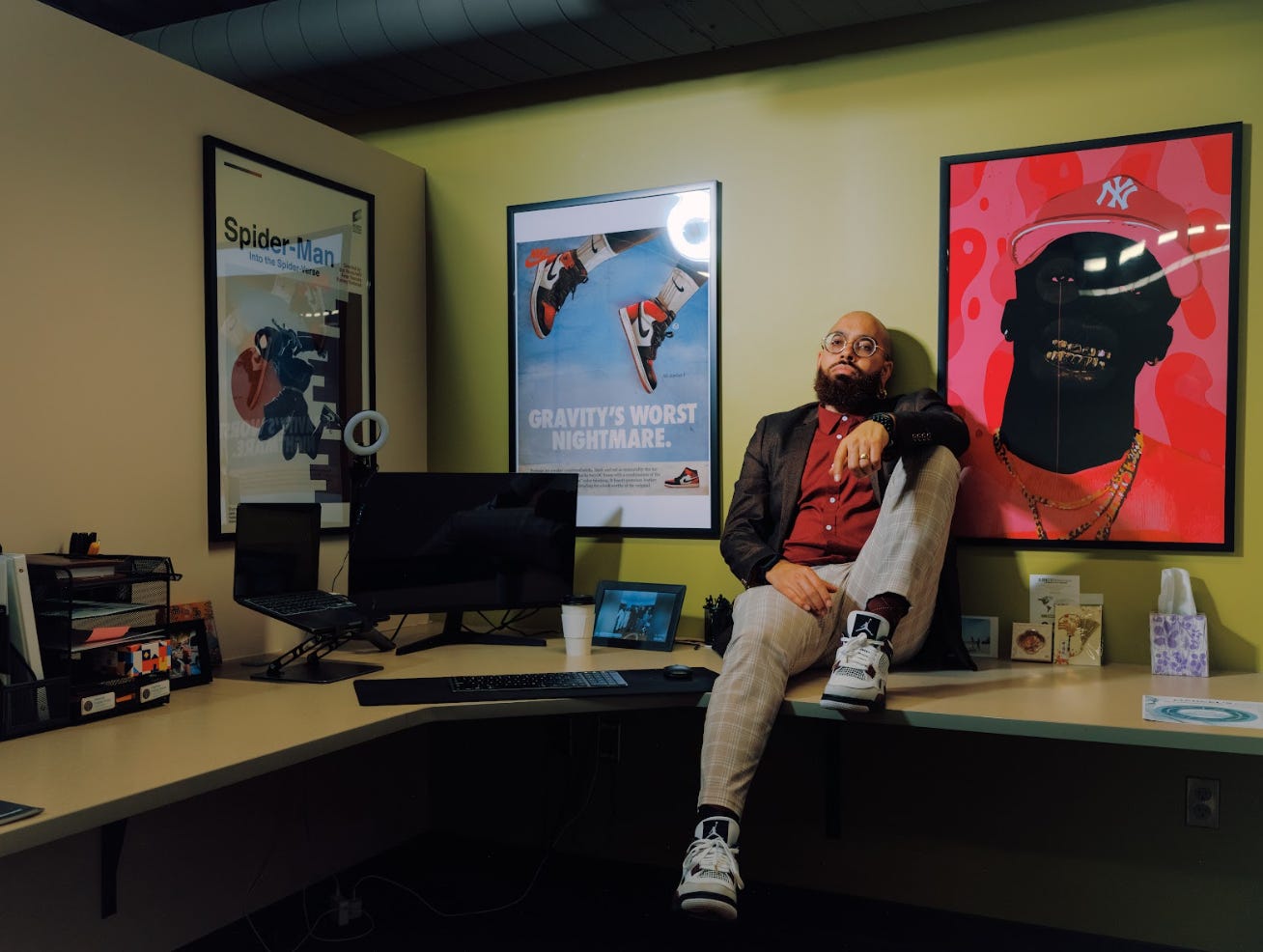
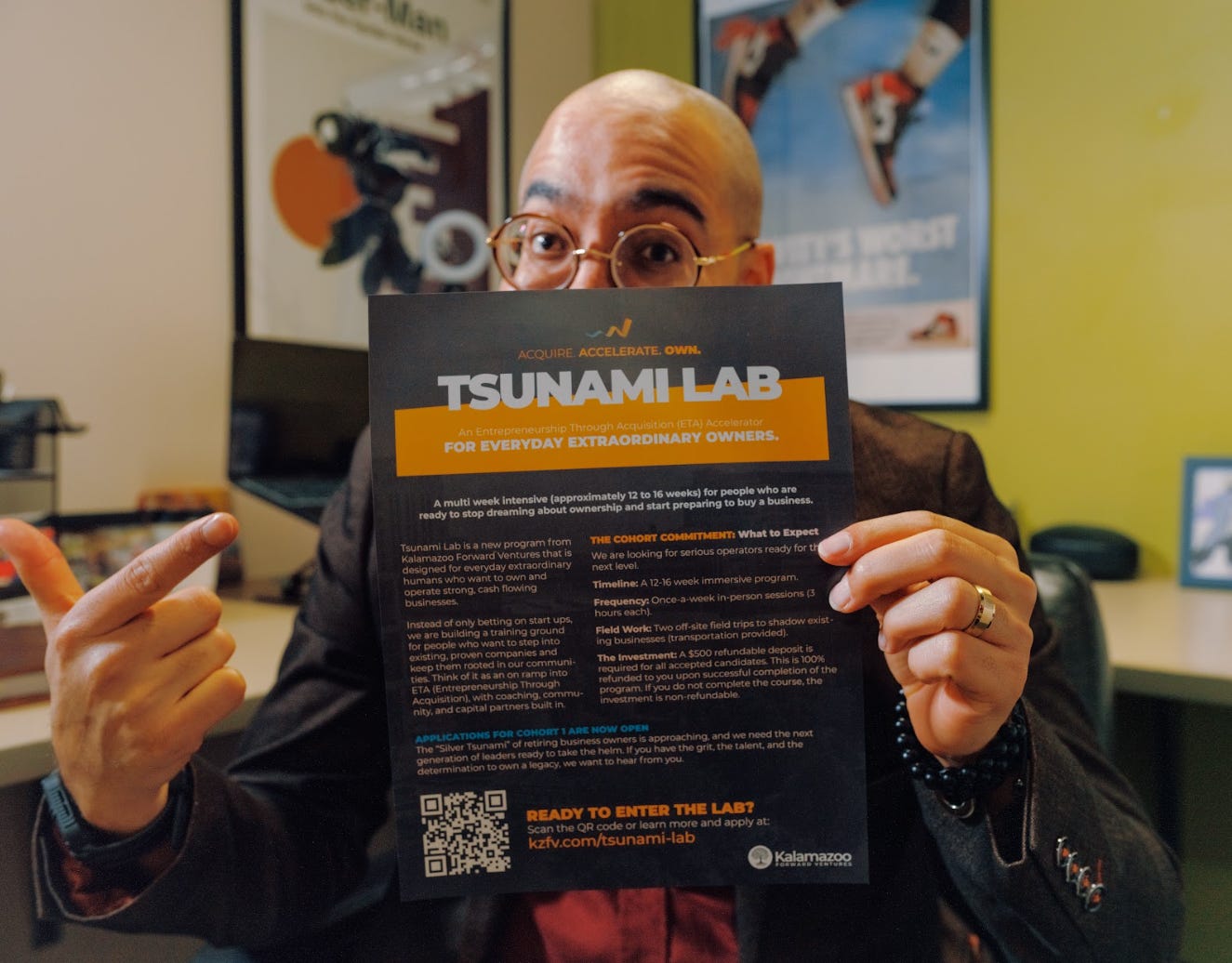
Applications are closing this week for Tsuanami Lab, a new entrepreneurship through acquisition program. Below is Marcel’s story entering the entrepreneur ecosystem, and the story behind the launch of the lab.
To some, I am the disruptor. To others, I am the artist, the poet laureate, the community advocate who founded a philanthropic organization rooted in dreaming radically and doing feverishly. But very few historically thought of my name as being synonymous with “entrepreneurship.” Even some of the brilliant minds on my own Professional Advisory circle don’t necessarily see my ability to create as something that is scalable or of significant economic value.
In their eyes, I was a “community guy.” They saw the heart, but didn’t see how it could steer an economic engine for change. Psh, but to be fair, there were days I didn’t see it myself; and ones I still doubt it now.
The Mirror of the “Miracle” Résumé
My tenure with the non-profit I founded came to a jagged end. I had taken that organization from a single sheet of paper; filing the articles of incorporation; to a multi-million-dollar entity. I did it as a non-college-educated, Michigan-born-and-bred founder. In a region that values pedigree and “Collegiate polish,” I was a glitch in the matrix.
When that chapter closed, I struggled to find my footing. I knew I had a love for consulting; an ability to fundraise that felt like a superpower; and a knack for designing large-scale, scalable systems. I founded The RE: GROUP because I knew so many philanthropic professionals who were suffocating on their own reliance on foundations. These were good people, brilliant people, but they didn’t know how to diversify revenue. They didn’t know how to lean into public-private partnerships or navigate the labyrinth of state, city, and county dollars. They had a mission, but they didn’t have a map. Even rarer was the authentic community support or the know-how to secure major individual gifts.
I thought I could be the guide. But after a short-lived time as a grantmaker with one of the oldest community foundations in the state, I hit a wall of realization. I didn’t want to be a career non-profit professional. At least, not right now.
I realized my drive to “learn everything I could” about philanthropy was rooted in a survival instinct. I believed the non-profit structure was the only way someone who looks, thinks, and lives like me could raise capital or scale a mission in West Michigan. I believed that if I wanted to do good, I had to ask for permission through a grant application. I honestly still don’t entirely disbelieve that the system is rigged that way; but now, I am yearning to prove that reality is not the only option.

The Enchantment of the $50 Million Announcement
Then came the shift.
When I saw Kalamazoo Forward Ventures (KzFV) come on the scene; six Black men making a $50 million announcement; I wasn’t just captivated. I was taken back in a way I can barely describe. As someone who felt like an anomaly for having raised $6.5 million in a philanthropic space; a journey that came with death threats, county officials wanting my head, and a chorus of voices telling me my fall would be as fast as my rise; seeing KzFV was like seeing a mirror from the future.
In West Michigan, the unwritten rule is that you don’t refuse to “kiss the rings.” I had spent my career refusing. I had watched as the elite maintained control while the middle class was ruled by philanthropy. I saw people giving their lives to work that resulted in no tangible equity. They were moving the needle for the city, but their own dials stayed at zero.
So, when I saw six people launch an investment firm; a for-profit entity designed to invest in other underinvested humans; I became enchanted. I attended their launch event and was mesmerized by the stories, but more importantly, I was emboldened by the mission. They were navigating the world by pouring into those who weren’t at the table, and they were doing it through a for-profit framework.
In February 2025; Black History Month, ironically enough; I began my role as Director of Community & Strategic Engagement at KzFV. For the first time in my professional life, I had the capacity to learn without the immediate threat of the plane crashing.
As a founder, I was always building the plane while flying it. I was trying to land without killing anyone while simultaneously using the plane to assist others. I was busy. I didn’t prioritize learning outside of mentorship. But now, I was taking professional development classes. I was reading everything I could find. I completed VC University through Berkeley, which opened my eyes to an industry that felt both alien and strangely familiar. I realized that being a founder of a philanthropic institution is almost identical to being the founder of a venture start-up. Being a grantmaker is the mirror image of being an equity-based funder.
The mechanics were the same; only the currency had changed.
The Pivot to Main Street
In early 2026, my role refined. I received a promotion to work exclusively with our Main Street pillar under Managing Partner Dwayne Powell Jr.
Dwayne is one of the founders of KzFV and, frankly, one of my favorite leaders I’ve ever worked for. He is a brilliant, tenured economic developer who knows the soul of Kalamazoo because he is native to it. We started to notice something in the fall of 2025. As a new fund, we were looking at the staggering failure rate of start-ups. In the Venture Capital world, you expect most to fail because the few that win, win big. But Main Street is different. Main Street is about the anchors.
Dwayne noticed a trend in our data. Out of nearly 300 Main Street applications, only 5% had over $150,000 in revenue. Even fewer had existing assets or “clean” books. When you look at the success rate of a brand-new start-up compared to the success rate of Entrepreneurship through Acquisition (ETA), the appeal as an investor becomes crystal clear.
This is where the disruptor in me started to get excited. I realized that if we wanted to move the needle on economic justice, we couldn’t just keep starting from zero. We had to start buying the rooms we were already standing in.

The Arithmetic of the Silver Tsunami
We have to talk about the math, because the math is the only thing that doesn’t lie.
Nationally, we are facing what economists call the “Silver Tsunami.” Baby boomers currently own about 2.3 million privately held employer businesses.* These firms are the heartbeat of the American economy; providing 25 million jobs and generating over $5 trillion in annual revenue.* When these owners retire; and they are retiring in droves; we face a systemic risk. If there is no one to buy these businesses, they close. The lights go out. The jobs disappear. The wealth is extracted by distant corporations.
But look at the disparity in the current ownership landscape:
Women-Owned: ~22% of employer firms.*
POC-Owned: ~18-20% of employer firms.*
Black-Owned: ~3.3% of employer firms.*
The representation gap is a canyon. Black folks make up over 14% of the population but own barely 3% of the businesses that actually employ people. In Michigan, the numbers follow the same tragic curve. We have roughly 81,500 boomer-owned firms.* These businesses provide nearly one million jobs; that is 1 in 5 private-sector jobs in our state.*
In West Michigan; my own backyard; Black ownership of employer firms hovers around 2%.* This is where the “Tsunami” becomes an opportunity for a “miracle.” If we moved just FIVE businesses a year in West Michigan into the hands of Women, POC, or Black owners, we would fundamentally shift the regional economy.
In 3 years, we would increase the total number of Black-owned employer firms in the region by almost 8%.
In 5 years, we would move the needle by nearly 13%.
We are talking about a $50 million transfer of wealth and power over five years just by ensuring these businesses don’t go dark. This isn’t a “program”; it’s a revolution.
Tsunami Lab: The Justice League of Program Design
I have always used my work to create what I needed and didn’t have. As a teaching artist, I created the stages I needed as a kid. Now, as an entrepreneur and a leader at KzFV, I am creating the infrastructure I need as an adult.
We built Tsunami Lab to be that infrastructure.
It is an acquisition accelerator designed to reduce the friction in ownership changes. We are assembling a “Justice League” of program creators to equip leaders with the tools to identify, evaluate, and acquire existing businesses. We aren’t looking for early-stage concepts that burn through cash; we are looking for real companies with employees, customers, and cash flow.
Tsunami Lab is for the operator who has the leadership capability but doesn’t have a “novel startup idea.” It is for the person who knows how to run a team but was never given the keys to the building. We are taking the “red flags” that the system sees in our backgrounds and turning them into the “green lights” of a sustainable economy.
The coming week is the final week for applications. We are looking for the innovators, the risk-takers, and the disruptors who are ready to shake up the status quo by owning it. People can apply here: [Link].
The Spectrum of Entrepreneurship in Michigan
Michigan is blooming into a beautiful entrepreneurial renaissance. But we have to realize that entrepreneurship is a spectrum.
Not everyone is built to be a start-up founder; the person who builds something from a napkin sketch and a prayer. And not everyone is built for entrepreneurship through acquisition; the person who takes an existing engine and tunes it for the next fifty years. Both are valid. Both are vital.
I believe Michigan is the future. From the automotive legacy of Detroit to the Furniture City of Grand Rapids; from the biomed innovation statewide to the CPG power in Battle Creek; or the Public / Private savants in Kalamazoo, home of The Promise. Michigan inspires the world. But it is up to us to innovate in ways that continue to move the needle for the middle class and the underinvested.
I told myself I’d never lead again. I was exhausted; spiritually, emotionally, and financially. But something shifted. I realized I don’t just like leadership; I need it. I am at my best when I am responsible for building something meaningful. Something sustainable. Something that can/will outlive me.
We are going to attack unemployment and economic disparities by utilizing the systems we have and getting more disruptors into positions of ownership. We are going to preserve the businesses that already sustain our communities.
We are going to take the “Silver Tsunami” and turn it into a reservoir of equity.
Even if it is one program, one acquisition, one transfer of wealth at a time.
Peace, Love, and Creativity
Marcel Fable Price
Founder, The RE: GROUP Strategies.
Director of Platform and Programming @ Kalamazoo Forward Ventures.
*Citations and Resources:
Project Equity: The Small Business Closure Crisis (Michigan & National)
U.S. Census Bureau: Annual Business Survey (ABS) 2023/2024
Note: This is the definitive source for ownership by sex, race, and ethnicity.
Brookings Institution: Black Employers are Reaching New Heights (2024/2026)
SBA Office of Advocacy: 2024 Small Business Profile (Michigan)
Exit Planning Institute: State of Owner Readiness Report
 | A guest post by
|